How Much Grease Comes Out in One Pump?
There is no fixed amount of grease in one pump: output depends on the gun and how you operate it. Measure several consistent strokes from your primed gun to estimate its average output.
On this page (10 sections)
- How much grease is in one pump?
- How do you measure grease per pump in grams?
- Why does grease output change from pump to pump?
- Do cordless grease guns deliver a fixed amount per trigger pull?
- Which grease gun should you choose for measuring output?
- How many pumps should you use on a fitting?
- Does grease gun pressure tell you how much comes out per pump?
- What mistakes make a pump count unreliable?
- How do you keep a useful output estimate?
- How much grease is in one pump: what should you choose?
There is no fixed amount of grease in one pump. The output depends on the gun, whether it is primed, and how consistently you operate it, so measure your own gun before using a stroke count to estimate a dose.
The search for how much grease is in one pump has no single answer that applies to every hand or cordless gun. A pump count becomes useful only after you know the approximate output of your own gun and the equipment instructions allow you to estimate lubrication that way.
How much grease is in one pump?
One pump can deliver different amounts depending on the grease gun and the stroke. A partial squeeze may move less than a full stroke, while air in the pump can interrupt delivery until the gun is primed.
Your useful number is the average output from several consistent strokes. If a fitting or bearing needs a specific amount, follow the equipment maker’s lubrication instructions instead of assuming every pump is equal.
How do you measure grease per pump in grams?
Weigh several full strokes and divide the total by the number of strokes. Collecting a larger sample makes small differences in hand movement or scale readings matter less.
- Prime the gun and confirm that grease flows steadily.
- Put a clean container on a scale and zero it.
- Pump 10 full strokes into the container.
- Divide the grease weight in grams by 10.
- Repeat if the result varies or seems inconsistent.
For example, if 10 strokes weigh 30 g, the average for that measurement is 3 g per stroke. That is an illustration of the calculation, not a general output figure for grease guns.
Use a scale that can register small weight changes. Keep the stroke length and pace consistent, and don't count partial squeezes as full strokes.
How much grease is in one pump when measured in ounces?
You can estimate ounces per pump by measuring several strokes together. A small amount may be hard to read in a marked container, so collect enough grease to get a clear measurement and divide by the stroke count.
Weighing is often easier to repeat because grease can cling to the sides of a container. Also, ounces by weight and fluid ounces by volume are different measurements, so don't treat them as interchangeable.
Why does grease output change from pump to pump?
Output changes when stroke length, priming, or the way you operate the gun changes. Count strokes only while grease flows steadily and each stroke is complete.
Air in the head or barrel can interrupt flow. If the gun sputters or stops feeding, follow our guide to bleeding air out of a grease gun.
Changing cartridges or filling a gun with bulk grease may also require priming. Use our guides to changing a grease gun cartridge without a mess and filling a grease gun with bulk grease for those setups.
Does squeezing harder change how much grease is in one pump?
A complete, repeatable stroke gives you a better estimate than a partial squeeze. Move a hand gun through its full range each time you measure it.
Don't force a handle that binds or feels unusually stiff. Check the gun’s instructions and make sure it is assembled and primed before continuing.
Do cordless grease guns deliver a fixed amount per trigger pull?
No, a flow rate per minute does not tell you the amount from one trigger pull. The trigger may be held for a fraction of a second or several seconds, so duration affects how much grease moves.
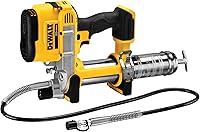
DeWalt says the DCGG571B pumps up to 5.0 oz per minute and has a variable-speed trigger. That makes it a fit for someone who wants powered delivery and control over how long the pump runs.
The 42 in flexible hose helps reach fittings that are hard to access, while the air-bleeder valve assists priming after a cartridge change. Choose another style if you prefer a simple hand-powered gun or want to count full manual strokes.
For a rough cordless estimate, collect grease over a set number of seconds and use the same trigger duration each time. A brief trigger tap is not a calibrated dose.
Which grease gun should you choose for measuring output?
Choose a hand gun for repeatable full strokes or a cordless gun when powered delivery suits the job. No pressure rating or flow rate, by itself, gives you a fixed amount per pump.
The LockNLube is rated up to 5,000 PSI and includes an in-line hose swivel. It fits users who value its locking coupler and hose setup; skip it if you need cordless operation or a longer hose.
The Lincoln 1133 supports standard grease cartridges and two-way loading, and its maximum pressure is 6,000 PSI. It suits readers who want a hand-operated gun with those loading options; choose another model if you specifically want variable-speed powered delivery.
If you're still matching a grease gun to your work, see what makes a good grease gun. For the next step at the fitting, read how to grease zerk fittings step by step.
How many pumps should you use on a fitting?
Use the equipment maker’s instructions to decide the target amount. Your measured output can help estimate a stroke count only when those instructions allow it.
If the specified amount is by weight, divide it by your measured weight per stroke for an approximate count. If the instructions say to grease until it appears at a seal, follow that condition instead of continuing by habit.
Stop if grease will not enter the fitting. Check the coupler connection and fitting, then see why a grease zerk won't take grease.
Does grease gun pressure tell you how much comes out per pump?
No, pressure and output per pump measure different things. A higher PSI rating does not tell you how many ounces or grams a gun delivers in one stroke.
Pressure describes the force available to move grease through a fitting or line. Output per stroke describes the amount moved during one pumping action, so see how much PSI a grease gun produces for more on pressure.
What mistakes make a pump count unreliable?
Partial strokes, air in the pump, and inconsistent trigger time can all distort your estimate. Calibrate only after priming, and repeat the same movement or trigger interval from one measurement to the next.
Don't compare a hand gun’s strokes with a cordless gun’s trigger pulls as though each represents the same dose. A cordless rate is measured over time, while a hand gun’s output is measured over complete strokes.
Avoid using an estimated count to override a machine’s lubrication instructions. If a fitting appears blocked, more pumping may not solve the problem.
How do you keep a useful output estimate?
Record the gun, grease, number of strokes, and measured weight after calibration. Recheck the estimate if you change guns, the output becomes uneven, or your technique changes.
Keep the gun clean and primed so grease flows steadily during future measurements. Our guide to cleaning a grease gun and keeping it working covers basic care.
Treat the result as an estimate for that gun and your way of operating it. Follow the equipment manual whenever it specifies an amount or method.
How much grease is in one pump: what should you choose?
There is no universal amount of grease in one pump; measure your own gun and follow the equipment instructions. Choose a hand gun if you want to count full strokes, or a cordless model if controlling delivery by trigger time fits your work.
The LockNLube suits users who want a locking coupler, while the Lincoln offers two-way loading for standard cartridges. Keep your estimate tied to the gun and technique you measured, and use our step-by-step guide to greasing zerk fittings when you need help applying grease.
Frequently asked questions
How many ounces of grease does one pump deliver?
There is no universal ounces-per-pump amount. Output changes with the grease gun's pump design, stroke length, priming, and how completely you work the handle.
Measure your gun by pumping into a suitable container and weighing the grease, then divide by the number of full strokes.
How many grams of grease come out of one pump?
The number of grams varies by grease gun and stroke, so a general grams-per-pump figure can mislead. Weigh grease from several full strokes and divide the total grams by the stroke count.
Repeat if you change guns, cartridges, or pumping technique.
Does a cordless grease gun give more grease per pump?
A cordless gun may move grease at a stated flow rate, but that rate is not the same as a fixed amount per trigger pull. DeWalt states up to 5.0 oz per minute for its DCGG571B.
Actual output per trigger interval depends on how long you run it.
How can I measure grease gun output accurately?
Use a scale that registers small changes, pump a known number of full strokes into a container, and divide the grease weight by the stroke count. Keep the gun primed and use the same stroke each time.
For ounces by volume, use a marked container and measure several strokes together.