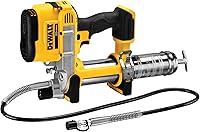
How Much PSI Does a Grease Gun Make?
A grease gun can produce about 7,500 to 10,000 PSI at its maximum, depending on the model. How much PSI a grease gun produces does not tell you how much grease a joint needs.
On this page (7 sections)
A grease gun can produce about 7,500 to 10,000 PSI at its maximum, depending on its design. If you're asking how much PSI a grease gun produces, remember that maximum capacity is not the pressure every fitting needs.
The Alemite 555-E manual gun is rated up to 7,500 PSI. The DeWalt DCGG571B and Milwaukee 2646-20 cordless guns reach 10,000 PSI, while their controls give you different ways to manage pressure or flow.
The right choice depends on how often you grease, where the fittings sit, and whether you need a manual or battery-powered tool. A higher number does not make a gun the best match for every machine.
How much PSI does a grease gun produce?
Many high-pressure grease guns reach about 7,500 to 10,000 PSI at maximum. Those ratings describe what a model can develop under its designed conditions, not a recommended setting for every joint.
Grease guns move lubricant through a hose and coupler into a fitting. Pressure helps overcome resistance, but the fitting, hose, coupler, grease and condition of the joint all affect how the grease moves.
Use the equipment maker's lubrication instructions as your guide. If grease won't enter with controlled operation, investigate the fitting instead of treating the gun's maximum PSI as a reason to force it.
What does the PSI rating tell you?
PSI tells you the pressure a gun can develop, not how much grease a joint needs. Grease volume depends on the tool's design and operating mode as well as how long or how often you pump.
A cordless gun can make repeated pumping less tiring during frequent maintenance. The user still has to control grease delivery.
The DeWalt DCGG571B has a variable-speed trigger and a high-flow rate of up to 5.0 oz per minute. Milwaukee's 2646-20 uses a 2-speed design for maximum pressure or maximum flow.
A manual gun gives direct control through each stroke. The Alemite 555-E specifies 1 oz per 30 strokes in high-volume mode, and its lever can switch between pressure and volume modes.
Use a measured approach: follow the equipment instructions, pump gradually, and watch for grease at the joint. For more help estimating a dose, read how much grease comes out in one pump.
Is 10,000 PSI too much for a grease fitting?
It can be too much for a fitting, seal, or joint, even when the gun is rated for it. A gun's maximum pressure is a limit of its capability, not a safe target for every lubrication point.
Use the equipment maker's instructions and stop if grease leaks around the coupler or seal, a fitting shifts, or the joint resists grease. Don't lean harder on a lever or hold a trigger longer to overpower a blockage.
Pressure ratings matter throughout the connection. Check the hose and coupler ratings, and inspect them for damage.
Make sure the coupler is seated before pumping. The LockNLube locking coupler's 10,000 PSI rating describes that coupler, not a pressure setting for the machine.
If a fitting will not accept grease, pause and diagnose it. This guide to why a grease zerk won't take grease covers common causes.
How should you choose a grease gun for the job?
Choose for your maintenance routine, access needs, and control preference, then check the pressure rating. For occasional service, a manual model may be enough; frequent work across many fittings can make a cordless gun more convenient.
The DeWalt DCGG571B suits mobile maintenance when a long hose and trigger control are useful. Its 42 in flexible hose reaches fittings that are harder to access, and an LED helps in dark work areas.
It is a tool-only model, so make sure its battery system fits your needs. Skip it if you prefer a manual gun or don't need a powered tool.
Milwaukee's 2646-20 suits users who want a 2-speed cordless option. Its 48 in hose provides reach, while the preset grease counter dial supports measured dispensing.
Skip it if you don't need cordless operation or would rather control each pump by hand.
The Alemite 555-E suits people who prefer a manual tool with a choice between volume and pressure modes. Its 18 in flexible hose and quick-priming design fit varied lubrication tasks.
Skip it if frequent, high-volume work makes repeated hand pumping impractical.
A locking coupler can be useful if keeping the connection secure and freeing both hands would help. The LockNLube coupler fits manual, battery and pneumatic guns, but it is an accessory, not a grease gun.
Skip it if your current coupler already connects securely and releases cleanly.
For automotive work, compare the needs in our guide to grease guns for cars and trucks. If you're weighing cordless models, see the DeWalt DCGG571B and Milwaukee M18 comparison and the grease guns for home use guide.
How do you set up and use a grease gun?
Start with a correctly loaded, primed gun and a clean, secure connection. A careful setup helps prevent air pockets, messy leaks, and wasted grease.
Read the tool instructions before loading a cartridge or bulk grease. Keep grease and fittings clean so dirt doesn't enter the joint, then prime the gun as directed.
The DeWalt DCGG571B and Milwaukee 2646-20 include air-bleeder valves to assist priming after cartridge changes.
Attach the coupler straight onto the fitting, then operate the gun gradually. Watch the joint as grease moves in, and stop at the amount recommended for that equipment.
If you're new to the connection process, follow how to grease zerk fittings step by step.
If the gun fails to deliver grease after loading, trapped air may be the cause. Follow the maker's priming procedure or use our guide to bleeding air out of a grease gun.
What common grease gun mistakes should you avoid?
Don't use maximum pressure to compensate for a problem you haven't diagnosed. A blocked fitting or poorly seated coupler calls for inspection, not harder pumping.
Avoid pushing the coupler on at an angle, since a poor connection can leak grease. Don't keep pumping when grease escapes around the joint, and don't assume a fitting needs more lubricant just because the gun can deliver more.
Keep the hose and coupler in good condition. A damaged connection can leak or fail under pressure, so stop using it and replace it with a compatible part.
Clean grease from the coupler after use, store the gun as its instructions direct, and keep the grease free of dirt.
How much PSI does a grease gun need?
A grease gun needs enough pressure to feed the fitting according to the equipment instructions, not its full maximum rating. Choose the DeWalt for trigger-controlled cordless use, Milwaukee for 2-speed cordless control, or Alemite for manual volume and pressure selection.
If the fitting resists grease, stop and inspect it before increasing force. Use the zerk fitting guide to check the connection and lubrication steps.
Frequently asked questions
How much PSI does a manual grease gun produce?
Manual grease gun pressure depends on the model and its leverage. The Alemite 555-E is rated up to 7,500 PSI and switches between volume and pressure modes.
Follow the tool instructions and use controlled strokes at the fitting.
Is 10,000 PSI too much for a grease gun?
A 10,000 PSI maximum is a capacity, not a target for every fitting. Use the equipment maker's lubrication instructions and stop if grease escapes around the coupler or a seal.
Check the hose and coupler ratings as well as the gun's.
Does a grease gun's PSI affect how much grease comes out?
PSI alone doesn't tell you the amount per stroke or trigger pull. The gun's design and operating mode affect grease flow; the Alemite 555-E, for example, offers separate volume and pressure modes.
See how much grease comes out in one pump for help estimating a dose.
Can the grease gun coupler lower pressure?
A coupler connects the hose to a fitting; its pressure rating doesn't set or reduce the gun's output. The LockNLube locking coupler is rated to 10,000 PSI.
Check the ratings and instructions for both gun and coupler before use.