What Makes a Good Grease Gun?
A good grease gun feeds grease reliably, reaches the fitting, and gives you control without making routine work harder. Choose the power source, hose, grip, and priming features that fit your jobs.
On this page (8 sections)
- What makes a good grease gun easy to use?
- How should you choose between manual and cordless grease guns?
- How much hose reach do you need for a good grease gun?
- What do pressure and flow control tell you?
- What helps a grease gun prime after loading?
- Which grease gun features matter for your work?
- What is a good grease gun for home, farm, or shop use?
- Which grease gun should you choose?
A good grease gun feeds grease reliably, reaches the fitting, and gives you control. If you're asking what is a good grease gun for your jobs, start with how often you grease, how awkward the fittings are to reach, and whether you want to pump by hand.
A pistol-grip gun can suit occasional home maintenance. For repeated jobs or hard-to-reach fittings, a cordless model with a longer hose and useful controls may save effort.
What makes a good grease gun easy to use?
A good grease gun is easy to use when its grip, hose, and grease flow fit your work. A comfortable handle matters if you grease many points, while a controllable trigger can help you manage how much grease you dispense.
Think through your working position before choosing. You may need to hold the tool steady with one hand, guide the hose with the other, or reach around a machine frame.
A pistol-grip design keeps the handle and barrel close together. A cordless model reduces repeated hand pumping, but tool-only models may require a separate battery and charger.
How should you choose between manual and cordless grease guns?
Choose a manual grease gun for occasional jobs and cordless power for frequent work where repeated pumping would slow you down. A manual gun avoids battery needs; a cordless one reduces hand pumping and may add controls or lights.
A hand-powered gun is a straightforward choice for a garage or a small number of accessible fittings. It also suits people who prefer a simple tool and don't mind pumping by hand.
Cordless guns use a motor to push grease. Their battery systems and included equipment differ, so check what you already own and what comes with the gun before deciding.
The LockNLube Heavy-Duty Pistol Grip Grease Gun is a practical pick for occasional maintenance when you want a hand-powered tool and a coupler that locks onto the fitting. It has a 20 in hose, an in-line swivel, and a hose storage feature.
Choose it if you want a manual gun with a dedicated coupler and simple storage. Skip it if you grease many points in a row or prefer motor-assisted pumping.
For household maintenance, compare more options in our guide to grease guns for home use.
How much hose reach do you need for a good grease gun?
Choose a hose that reaches your fittings without forcing an awkward position. A flexible hose helps when a fitting sits behind a wheel, under equipment, or beside another part.
Hose length alone doesn't guarantee access. The fitting angle, surrounding parts, and room to move the gun all matter, so think about the tightest spot you regularly grease.
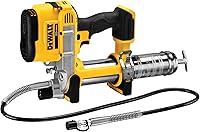
The DeWalt DCGG571B has a 42 in flexible hose for hard-to-access fittings. The Milwaukee 2446-20 includes a 36 in flex hose with a spring guard.
The DeWalt DCGG571B suits frequent work where hose reach and trigger control matter. It has a variable-speed trigger, LED, integrated foot, and an air-bleeder valve to help prime after cartridge changes.
Choose it if you want long reach and adjustable flow. Skip it if you need a complete battery setup in the box, since this is a tool-only model.
The Milwaukee 2446-20 M12 Grease Gun fits buyers who already use its battery system and want a cordless tool with a hose-storage feature. It has an air-bleeder valve and a 36 in flex hose with a spring guard.
Choose it if that reach and battery platform fit your work. Skip it if you need a battery and charger included, because this tool is sold without them.
For farm machinery, compare options in our tractor grease gun guide.
What do pressure and flow control tell you?
Pressure and control serve different purposes: pressure is one factor in pushing grease through a resistant fitting, while flow control helps you manage how quickly grease comes out. A high pressure rating by itself doesn't make a gun the right fit for every job.
A variable-speed trigger lets you adjust flow by changing how you press it. That can help when you want to work carefully around a seal or avoid pumping more grease than needed.
The DeWalt DCGG571B reaches up to 10,000 PSI and has a variable-speed trigger. The Lincoln 1884 PowerLuber also reaches up to 10,000 PSI and has a trigger-operated 2-speed design.
The Lincoln 1884 PowerLuber suits buyers who want a cordless kit with two battery packs, a charger, a case, and a 36 in high-pressure hose. Its 2-speed operation is intended for light and medium-duty lubrication tasks.
Choose it if a ready-to-carry setup and two speed options are useful for your work. Skip it if you prefer a lighter tool or already have a battery platform you want to use.
Don't treat pressure as a fix for every problem. If grease won't enter, check the coupler connection and fitting, then follow the equipment manufacturer's maintenance instructions.
What helps a grease gun prime after loading?
A good grease gun should be straightforward to prime after loading or changing a cartridge. Trapped air can interrupt grease flow, so a vent or bleeder valve can make that step easier.
Follow the gun's instructions for loading and priming. Don't force the handle or trigger if the tool isn't feeding grease.
The DeWalt and Milwaukee models both include air-bleeder valves. The Lincoln 1884 has a built-in vent valve for purging trapped air.
Read how to bleed air out of a grease gun for the priming steps. For cartridge loading, our guide to changing a grease gun cartridge covers the process.
Which grease gun features matter for your work?
Prioritize features that solve a specific problem in your routine. A long hose can help with access, a storage method keeps the hose contained, and a stable base can help when you need to set the tool down.
Use this checklist before you buy:
- Hose length and flexibility: Compare the hose with your least accessible fitting.
- Grip and trigger: Consider how you hold the gun and control grease flow.
- Priming valve: Useful for clearing trapped air after loading.
- Hose storage: Helps keep the hose contained between jobs.
- Light or stable base: Can help in dim work areas or when setting the tool down.
A shoulder strap, case, or LED may help if you move between equipment or work in cramped spaces. These features matter when they fit your jobs, not as a substitute for suitable reach and comfortable handling.
What is a good grease gun for home, farm, or shop use?
A good grease gun for your setting matches the number of fittings, access, and pace of the work. For a few accessible points, a manual gun may be enough; for repeated jobs, cordless power can reduce hand pumping.
For home use, focus on easy loading, a grip you can manage, and enough hose to reach your equipment. For farm work, think about how often you grease and whether a longer hose, light, or carrying case helps you move around machinery.
In a shop, choose a cordless model with flow control and priming features if you regularly service many fittings. Before you start, follow the steps for greasing zerk fittings and the equipment manufacturer's instructions for the correct lubricant and amount.
Which grease gun should you choose?
Pick the LockNLube if you grease occasionally and want a hand-powered pistol grip with an included coupler. Choose the DeWalt for a long hose and variable flow, the Milwaukee if its battery system and hose reach suit your jobs, or the Lincoln if you want a cordless kit with batteries, charger, and case.
Match hose reach to your hardest-to-access fitting, then check whether you need a battery, charger, or storage case. For occasional household jobs, compare grease guns for home use; the right choice is the one that reaches your fittings and gives you control at the pace you need.
Frequently asked questions
What makes a grease gun easy to use?
A grease gun is easier to use when its grip, hose reach, and grease flow suit the fittings and working position. A flexible hose helps with awkward access, while a controllable trigger or pistol grip can make dispensing easier to manage.
A priming valve can help after a cartridge change.
Is a manual or cordless grease gun better?
A manual grease gun suits occasional jobs and people who want a hand-powered tool. A cordless model can reduce repeated hand pumping during larger jobs, but it depends on a compatible charged battery.
Compare reach, priming, and how often you grease before choosing.
Why does a grease gun need an air bleeder?
An air bleeder helps release trapped air so grease can flow after loading or changing a cartridge. If a gun won't pump, follow its instructions to prime it before assuming a fitting is blocked.
Our guide to bleeding air from a grease gun walks through that process.
How long should a grease gun hose be?
Choose a hose long enough to reach your fittings while you keep a steady position. Longer hoses can help with recessed or hard-to-reach points, but they may be harder to manage and store.
Check the hose length and the access around your equipment before you choose.