Ryobi vs DeWalt Grease Gun: Which Is Worth It? (November 2026)
Choose DeWalt for a longer hose and variable speed control; choose Ryobi for its higher stated flow rate and 18V ONE+ platform. Both offer 10,000 PSI maximum pressure, so reach and battery compatibility are useful deciding points.
On this page (8 sections)
- Ryobi vs DeWalt grease gun: which fits your work?
- Which gun reaches fittings more easily?
- Does Ryobi’s higher flow rate make it the better pick?
- Which gun gives you more control?
- What comes with each Ryobi or DeWalt option?
- What should you know before loading either grease gun?
- Which model is worth it for your battery setup?
- Related grease gun guides
Choose DeWalt for a longer hose and variable speed control; choose Ryobi for higher stated flow and an 18V ONE+ battery setup. In this Ryobi vs DeWalt grease gun comparison, both reach a stated maximum pressure of 10,000 PSI, so hose length, flow and included gear help narrow the choice.
The Ryobi P3410 is specified for up to 7.5 oz/min, while the DeWalt DCGG571B is specified for up to 5.0 oz/min. DeWalt counters with a 42 in hose, compared with Ryobi’s 30 in hose.

Ryobi vs DeWalt grease gun: which fits your work?
Choose DeWalt for the higher score and longer hose; choose Ryobi for its higher stated flow rate. Both models have a 10,000 PSI maximum pressure.
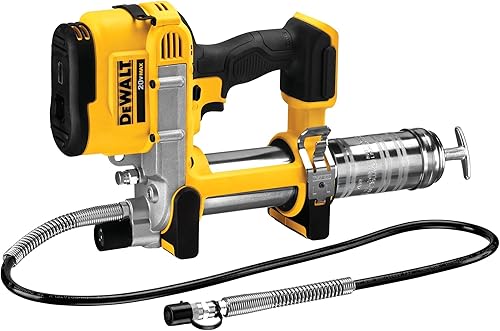
The DeWalt DCGG571B has a variable speed trigger, a 42 in flexible hose and an integrated foot that lets you rest it on a flat surface. The Ryobi P3410 has an 18V battery platform, a steel grease tube and an on-board LED work light.
These differences suit distinct setups. Compare your fittings’ locations and the batteries you already use before choosing.
Which gun reaches fittings more easily?
The DeWalt’s 42 in hose is longer than the Ryobi’s 30 in hose. That extra length can help you reach fittings set behind parts or farther from a comfortable standing position.
A longer hose gives you more routing room, but it can also take up more space when stored. The Ryobi includes on-board hose storage, while the DeWalt has an integrated foot for resting the tool on flat surfaces.
A flexible hose may still need a clear path and a secure coupler connection. For fittings that won’t accept grease, check our guide to why a grease zerk won’t take grease.
How do the Ryobi and DeWalt hoses compare?
The DeWalt hose measures 42 in, and the Ryobi hose measures 30 in. If your fittings are tucked behind a wheel or equipment frame, consider the route from the gun to each fitting, not just the straight-line distance.
Either hose can be awkward if it bends sharply or catches on nearby parts. Plan where you’ll hold or rest the gun while connecting it.
Does Ryobi’s higher flow rate make it the better pick?
Ryobi has the higher stated maximum flow rate at 7.5 oz/min; DeWalt is specified for up to 5.0 oz/min. That difference may appeal if you want to move grease through a job faster, but maximum figures don’t tell you the exact output at every fitting.
Grease type, air in the system and the fitting itself can affect how smoothly grease moves. Both models have an air bleeder valve to help prime the pump after changing a cartridge.
Use the output figures as one comparison point, then consider reach and trigger control. Our guide to how much grease comes out in one pump explains why pump output is useful to understand when you need to avoid over-greasing.
Which gun gives you more control?
DeWalt has a variable speed trigger, while Ryobi has a lock-on/lock-off trigger. The DeWalt trigger lets you control grease flow, and Ryobi’s lock-on/lock-off feature is designed to help avoid a workplace mess.
A variable speed trigger can suit a job where you want to manage flow as you work. A lock-on/lock-off trigger offers a different kind of control, so consider which approach feels easier to manage for your tasks.
Neither trigger removes the need to follow the equipment maker’s service instructions for lubrication.
What comes with each Ryobi or DeWalt option?
The Ryobi P3410 and DeWalt DCGG571B are tool-only options; the Ryobi kit includes a battery and charger. The kit includes a 1.3 Ah battery, and the battery and charger style may vary.
If you already have a battery that fits your setup, a tool-only model may suit you. If you’re starting without one, factor the included Ryobi battery and charger into your choice.
The Ryobi P3410 also has plunger rod markings to help gauge how much grease remains in the tube. The DeWalt package includes a shoulder strap, and its integrated foot can rest on flat surfaces.
What should you know before loading either grease gun?
Both models have an air bleeder valve, which helps prime the pump and reduce air pockets after cartridge changes. Correct loading and priming can make it easier to get grease flowing consistently.
Follow the instructions for your exact model when installing a cartridge. If the gun won’t pump after loading, our guide explains how to bleed air out of a grease gun.
Clean off excess grease after use and store the hose as the instructions allow. Our guide to changing a grease gun cartridge covers the steps for a cleaner change.
Which model is worth it for your battery setup?
Pick the DeWalt DCGG571B if you value its longer hose and variable speed trigger; pick the Ryobi P3410 if higher stated flow and the 18V ONE+ platform fit your work. Choose the Ryobi kit if you need a battery and charger included.
The Ryobi and DeWalt both offer 10,000 PSI maximum pressure, so a pressure tie doesn’t settle the choice. Measure the reach you need, think about how you prefer to control flow, and check which battery setup makes sense for you.
For another brand comparison, see our Milwaukee M12 vs M18 grease gun guide. If you’re comparing Ryobi’s tool-only model with the kit, our Ryobi 18V ONE+ grease gun review covers the P3410.
Related grease gun guides
- Milwaukee M12 vs M18 grease gun
- DeWalt DCGG571 vs DCGG581 grease gun
- Ryobi 18V ONE+ grease gun review
- Best grease guns for home use
Frequently asked questions
Which grease gun has the longer hose, Ryobi or DeWalt?
The DeWalt DCGG571B has a 42 in flexible hose, while the Ryobi P3410 has a 30 in hose. The extra reach can help when a fitting sits behind a wheel or inside a crowded work area, though the hose still needs a clear route to the fitting.
Does the Ryobi or DeWalt grease gun have more flow?
The Ryobi P3410 is specified for up to 7.5 oz/min, compared with up to 5.0 oz/min for the DeWalt DCGG571B. These are maximum stated flow rates, so actual output can depend on the grease and working conditions.
Do the Ryobi and DeWalt grease guns have the same pressure?
Both are specified for a maximum pressure of 10,000 PSI. That shared maximum doesn't make them identical in use: the DeWalt has a longer hose and variable speed trigger, while the Ryobi has the higher stated flow rate.
Does the Ryobi grease gun kit include a battery?
The Ryobi 18V ONE+ Grease Gun Kit includes a 1.3 Ah battery and charger. Their style may vary, so check which version is supplied before you buy if the exact battery or charger matters to your setup.
Which grease gun should I choose for a first cordless setup?
The Ryobi kit is the straightforward choice if you need a battery and charger included. If you already use a compatible battery platform, compare the tool-only Ryobi and DeWalt by hose reach, trigger control and stated flow before deciding.