DeWalt Grease Gun 571 vs 581: Which Is Better? (November 2026)
For the dewalt grease gun 571 vs 581 choice, pick the DCGG581 for two speeds, a longer reinforced hose and higher stated flow. Choose the DCGG571 for its integrated foot and air-bleeder valve.
On this page (10 sections)
- DeWalt Grease Gun 571 vs 581
- DeWalt grease gun 571 vs 581: what changes?
- Which DeWalt grease gun suits your work?
- Does the DCGG581’s higher flow make it the better pick?
- When does hose length matter more than flow?
- Which model is easier to set down between fittings?
- Should you buy the DCGG581B or the DCGG581GD1 kit?
- How should you set up and care for either grease gun?
- What mistakes should you avoid with a cordless grease gun?
- Which DeWalt grease gun should you choose?
DeWalt Grease Gun 571 vs 581
For the dewalt grease gun 571 vs 581 decision, choose the DCGG581 when you want two speeds, more hose reach and higher stated flow. Choose the DCGG571 when its integrated foot and air-bleeder valve suit the way you work.
Both are DeWalt 20V MAX cordless grease guns rated up to 10,000 max PSI. Their practical differences are flow, hose length, speed settings, set-down support and what comes in the box.
The DCGG581B is a tool-only model, while the DCGG581GD1 kit includes an oil-resistant battery and charger. The DCGG571 is a separate model with a 42 in hose, a built-in foot and a valve that assists with priming after cartridge changes.

DeWalt grease gun 571 vs 581: what changes?
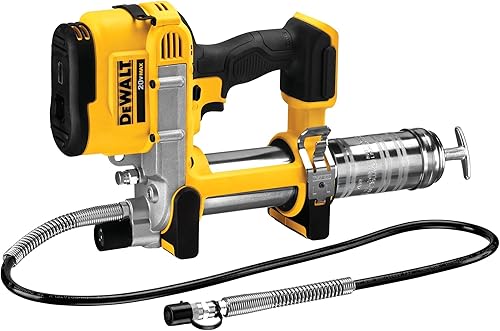
The DCGG581 prioritizes speed options and reach; the DCGG571 adds a built-in foot and an air-bleeder valve. Both have a variable speed trigger and LED lighting, so the choice comes down to how you control grease, reach fittings and set the tool down.
The DCGG571 has a 42 in flexible hose and a stated maximum flow of 5.0 oz per minute. The DCGG581 has a 47 in reinforced hose and a stated maximum flow of 9 oz per minute.
Those figures describe maximum rates, not a guaranteed output on every fitting. The shared pressure rating means that the clearest distinction is how each model handles flow and access.
How should you read the DCGG571 and DCGG581 model names?
The DCGG571B is the 20V MAX grease gun with a 42 in hose, variable speed trigger and integrated foot design. The DCGG581B is the two-speed tool-only model with a 47 in reinforced hose.
The DCGG581GD1 is the kit version of the 2-speed model. It shares the DCGG581's stated performance details and includes an oil-resistant battery and charger.
Check the full model code before buying, especially if you need a battery and charger in the same package. The DCGG581B and DCGG581GD1 are different package choices, while the DCGG571B has its own set of features.
Which DeWalt grease gun suits your work?
Choose the DCGG581 for repeated service rounds, varied fittings or jobs where higher stated flow and extra hose reach are useful. Choose the DCGG571 for work where its foot makes it convenient to rest the tool and its air-bleeder valve is useful after cartridge changes.
The DCGG581's two speeds give you a choice of operating modes, and its variable trigger lets you adjust flow as you work. That combination suits a mechanic or equipment owner moving between fittings that may call for different amounts of grease.
The DCGG571 is a good fit if you value a built-in way to rest the tool on a flat surface between fittings. Its air-bleeder valve also assists with pump priming after cartridge changes.
Either model can be a poor fit if you only grease a few easy-to-reach fittings now and then. A manual grease gun may be a simpler choice for occasional light work, since these cordless tools make most sense when their powered operation and hose reach will be used regularly.
Does the DCGG581’s higher flow make it the better pick?
The DCGG581 has the higher stated maximum flow, up to 9 oz per minute compared with up to 5.0 oz per minute for the DCGG571. That makes it the stronger fit for buyers who want more flow capacity during repeated maintenance rounds.
The maximum rate does not mean every fitting should receive grease at that speed. Use the trigger to control delivery and stop when the fitting or equipment reaches the amount called for by its maintenance instructions.
For jobs where you need to estimate grease output, see our guide to how much grease comes out in one pump. That guide can help you think about delivery in practical terms, though these electric models use a trigger rather than a manual pump stroke.
Both models have a variable speed trigger. The DCGG581 adds two speeds, which provides another way to set the tool for the task.
Is the DCGG581 the better DeWalt grease gun for faster work?
The DCGG581 is the better fit if higher stated flow and two-speed operation matter more than a built-in foot. Its maximum stated rate is 9 oz per minute, while the DCGG571's is 5.0 oz per minute.
For a single fitting or controlled application, use the trigger carefully instead of treating maximum flow as a target. A faster setting can be useful across many fittings, but grease still needs to go where the equipment requires it.
When does hose length matter more than flow?
Choose the DCGG581 when 5 in of extra hose reach helps you work around machinery. Choose the DCGG571 when its 42 in hose already reaches your fittings and you prefer its integrated foot.
The DCGG581's hose is 47 in and reinforced. The DCGG571's is 42 in and flexible.
Think about where the grease points sit, whether guards or other equipment block a straight approach, and where you can safely hold the gun while connecting the coupler.
Both models include an LED to help locate or align the nozzle in dim work areas. The light can help you see the fitting, but careful positioning still matters when attaching the coupler.
Our step-by-step guide to greasing zerk fittings covers access and technique. If grease will not enter a fitting, read why a grease zerk won't take grease before forcing more grease into it.
Which model is easier to set down between fittings?
The DCGG571 has the clearest advantage when you want to rest the tool on a flat surface between tasks. Its integrated foot design provides a built-in support point.
That feature can help when a job involves moving between several fittings and a stable surface is nearby. The DCGG581 has no integrated foot design specified, so consider where you can safely place it while working.
The DCGG571 also has an air-bleeder valve to assist with pump priming after cartridge changes. For a step-by-step explanation, read how to bleed air out of a grease gun.
For either model, keep the hose and coupler away from dirt, grit and places where the hose could be crushed. Wipe the coupler before connecting it, and store the tool so the hose does not drag through debris.
Should you buy the DCGG581B or the DCGG581GD1 kit?
Buy the DCGG581B if you already have the battery and charger you need; choose the DCGG581GD1 if you want those included with the gun. Both are two-speed DCGG581 models with a 47 in reinforced hose and a stated maximum flow of 9 oz per minute.
The DCGG581B is sold as a tool-only model, with its battery and charger sold separately. The DCGG581GD1 includes an oil-resistant battery and charger, so it makes sense for a buyer who needs those items with the tool.
The stated weight is 9.06 lb for the DCGG581B and 16.7 lb for the kit. The DCGG571 weighs 8 lb and includes a shoulder strap among its components.
Consider the whole setup before choosing a package. The tool-only version may suit an existing compatible battery setup, while the kit groups the gun with a battery and charger.
How should you set up and care for either grease gun?
Start with the correct grease and loading method, then prime the tool according to its instructions before attaching it to a fitting. Keep the coupler clean and use the variable trigger to control how much grease you deliver.
If you use cartridges, follow the steps for the exact model and check the cartridge is seated correctly. Our guide to changing a grease gun cartridge without a mess explains the process, and our guide to filling a grease gun with bulk grease covers the other common loading method.
After a cartridge change, the DCGG571's air-bleeder valve can assist with pump priming. Use the instructions for the DCGG581 to prime that model, and do not assume that the same priming steps apply to both guns.
Wipe grease from the coupler and nozzle area after use so dirt does not transfer to the next fitting. Keep the hose in a clean, protected position and inspect it before work for obvious damage or contamination.
What mistakes should you avoid with a cordless grease gun?
Avoid choosing by pressure alone, pushing grease into a blocked fitting, or treating the maximum flow rate as the right rate for every job. Match the model and the way you use its trigger to the equipment's service needs.
A 10,000 max PSI rating is shared by both models, so it does not settle the comparison. Hose length, flow control, package contents and the DCGG571's foot and air-bleeder valve are more useful buying distinctions.
Do not force grease when a zerk fitting will not accept it. Check the fitting and the equipment's maintenance guidance, then use our guide on why a grease zerk won't take grease to work through common causes.
Another common mistake is buying the tool-only DCGG581B when you need a battery and charger included. Confirm the complete model name and package contents before ordering.
Which DeWalt grease gun should you choose?
Pick the DCGG571 if the integrated foot and air-bleeder valve solve the most important parts of your routine. Pick the DCGG581B for two speeds, more hose reach and higher stated flow, or the DCGG581GD1 when you also need the included battery and charger.
The DCGG571 fits buyers who value a built-in way to rest the gun, need its 42 in hose and prefer a tool with a priming aid after cartridge changes. Skip it if two-speed operation, a longer reinforced hose or the higher stated maximum flow are your main priorities.
The DCGG581 fits frequent maintenance work where extra reach and flow capacity matter. Skip the tool-only DCGG581B if you lack the battery and charger you need, and choose the kit when you want those included.
For the wider dewalt grease gun 571 vs 581 choice, decide first whether reach and speed or set-down support and priming help matter more. Then compare other options in our guides to grease guns for home use, grease guns for tractors and farm use and Ryobi vs DeWalt grease guns.
Frequently asked questions
What is the difference between the DeWalt DCGG571 and DCGG581?
The DCGG581 has two speeds, a 47 in reinforced hose and a stated flow rate of up to 9 oz per minute. The DCGG571 has a 42 in flexible hose, up to 5.0 oz per minute and an integrated foot design.
Both are rated up to 10,000 max PSI.
Does the DCGG581 come with a battery and charger?
The DCGG581B tool-only version has its battery and charger sold separately. The DCGG581GD1 kit includes an oil-resistant battery and charger, so check the exact model name when choosing between the two.
Which DeWalt grease gun has a longer hose?
The DCGG581 models have a 47 in reinforced hose, 5 in longer than the DCGG571's 42 in flexible hose. Consider the fittings you need to reach and how you route a hose around machinery before choosing.
Can the DCGG571 help prime after changing a cartridge?
Yes. The DCGG571 has an air-bleeder valve that assists with pump priming after cartridge changes.
For the full loading process, follow the tool's instructions and see our guide to changing a grease gun cartridge without a mess.