Milwaukee M12 3/8 Ratchet Review: Worth It? (November 2026)
The Milwaukee M12 2457-20 is a compact 3/8-inch cordless ratchet for routine fastening in tight work areas, especially if you already have M12 batteries. This Milwaukee M12 ratchet review compares its low-profile head and controls with alternatives that offer more stated torque, interchangeable drives, or a battery and charger in the kit.
On this page (8 sections)
- What does the Milwaukee M12 ratchet review recommend?
- Who should choose the Milwaukee 2457-20?
- How does the Milwaukee compare with other cordless ratchets?
- How should you choose a cordless ratchet?
- How do you set up and use a cordless ratchet?
- What common cordless ratchet mistakes should you avoid?
- How do you care for a cordless ratchet?
- Is the Milwaukee M12 2457-20 worth choosing?
The Milwaukee M12 2457-20 is a compact 3/8-inch cordless ratchet for routine fastening in tight work areas, with a low-profile head, variable-speed trigger and 35 ft-lb of stated torque. This Milwaukee M12 ratchet review is most useful if you are choosing a ratchet for repair work and want to compare access, battery needs and included accessories.
The 2457-20 is a bare tool, so you need a compatible M12 battery separately. If you already use M12 tools, its platform may fit your shop; if you need more stated torque or a battery and charger included, compare the other options below.
What does the Milwaukee M12 ratchet review recommend?
Choose the Milwaukee 2457-20 when a compact head, M12 compatibility and straightforward 3/8-inch fastening are your priorities. Its controls and onboard light make it a practical option for work areas where access and visibility matter.
Milwaukee 2457-20 M12 3/8-inch Ratchet: Best for tight engine bays
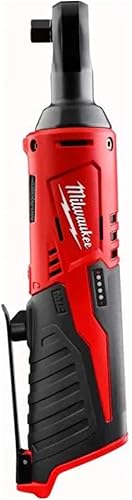
- 3/8-inch drive
- 35 ft-lb torque
- 250 RPM
- Low-profile head
- Battery not included
A compact M12 ratchet for automotive and repair work where a low-profile head and variable-speed trigger help. The tool is sold without a battery.
Pros
- Low-profile head for tighter spaces
- Variable-speed trigger
- Onboard fuel gauge and LED light
- Recessed forward-reverse switch
Cons
- Battery not included
- 35 ft-lb stated torque is lower than the listed alternatives
The 2457-20 measures 9.47 inches long and weighs 16 ounces. These measurements help you compare tools, but the actual room around a fastener also depends on the socket, your hand position and nearby parts.
Its recessed forward-reverse switch sits on the back of the head. That placement helps reduce accidental changes in direction while you work, and the variable-speed trigger lets you control how quickly the ratchet turns.
Who should choose the Milwaukee 2457-20?
Choose the Milwaukee if you already have compatible M12 batteries and want a 3/8-inch ratchet for repeated fastening in automotive or general repair work. The low-profile head can help when nearby parts limit access, while the LED can make a dim work area easier to see.
The fuel gauge shows the battery's remaining power on the side of the tool. That gives you a quick cue before starting a task or moving into a hard-to-reach area where swapping a battery would be inconvenient.
Skip this ratchet if you need a battery and charger in the same package, want interchangeable drive sizes, or put a higher stated torque figure first. The DeWalt, Craftsman and ACDelco each address one of those needs in a different way.
Drive size should come from the sockets and fasteners you use most. If you are still comparing sizes and models, our guide to best 3/8 cordless ratchets covers more options, while our electric ratchet wrench guide explains the basic role of a powered ratchet.
How does the Milwaukee compare with other cordless ratchets?
The Milwaukee's strongest case is its compact form and M12 platform. The alternatives offer a higher stated torque figure, changeable drive sizes, or a kit with power accessories and sockets.
| Ratchet | Stated torque | Stated speed | What sets it apart |
|---|---|---|---|
| Milwaukee 2457-20 | 35 ft-lb | 250 RPM | Low-profile head, M12 platform |
| DeWalt DCF503B | 60 ft-lb | Not stated here | Brushless motor |
| Craftsman CMCF935B | 40 ft-lb | 300 RPM | Interchangeable 1/4, 3/8 and 1/2-inch anvils |
| ACDelco ARW1209P | 45 ft-lb | 170 RPM, no load | Battery, charger and socket set included |
These figures help narrow the options, but they do not tell you which tool will fit a specific space or feel right with a particular socket. Treat torque and speed as comparison points, then check drive size, body shape and battery needs against your own tasks.
Is the DeWalt DCF503B a better fit for a Milwaukee M12 ratchet buyer?
The DeWalt may suit you better if higher stated torque and a brushless motor matter more than staying on the M12 platform. It also has a variable-speed trigger and an LED worklight.
The DeWalt is 14.37 inches long, compared with 9.47 inches for the Milwaukee. If you work between nearby components, consider whether the longer body has room to move; the battery and charger are also sold separately.
Choose the DeWalt for its torque figure and motor type if its battery setup works for you. Skip it if the shorter Milwaukee body or existing M12 batteries are more useful in your routine.
Does the Craftsman multi-size ratchet suit your work?
The Craftsman is a strong fit if you want to switch among 1/4, 3/8 and 1/2-inch drives with one ratchet. That flexibility can be useful when your fasteners and sockets vary across home and automotive repairs.
It has stated torque of 40 ft-lb and speed up to 300 RPM, with a variable-speed trigger. The tool weighs 2.7 lb, and its V20 battery and charger are sold separately.
Pick the Craftsman if changing drive sizes is more valuable than keeping the tool as light as possible. Skip it if you want a single compact 3/8-inch tool and do not expect to use the other anvils.
When does the ACDelco kit make more sense?
The ACDelco ARW1209P fits buyers who want a battery, charger and socket set in one kit. Its 3/8-inch ratchet has stated torque of 45 ft-lb and no-load speed of 170 RPM.
That bundle removes the need to source those included items separately. Its lower stated no-load speed may matter if you prioritize speed, so compare that figure with the Milwaukee and Craftsman before choosing.
Pick the ACDelco when you are starting without a compatible cordless tool battery and want sockets included. Skip it if you already have a battery platform you plan to keep using or want the faster stated speed of another option.
How should you choose a cordless ratchet?
Start with the jobs you do most, then compare drive size, access, battery platform and what comes in the package. A higher torque number alone is not enough to choose a ratchet for confined work.
For frequent automotive repairs, consider the size of the fasteners and the room around them. The Milwaukee's low-profile head is a clear reason to consider it for crowded areas, while the longer DeWalt may be a better match when its higher stated torque is the priority and its length fits.
Think about battery ownership before comparing bare tools. The Milwaukee and DeWalt need separate batteries, and the Craftsman needs a separate V20 battery and charger; the ACDelco kit includes its battery and charger.
A multi-size anvil is helpful only if you will use those drive sizes. If most of your sockets share one drive, a single-drive ratchet can keep the choice simple, while the Craftsman's interchangeable anvils give you more flexibility across different tasks.
Finally, compare kit contents and the work environment. A socket set can help if you are building a tool collection, and a light or fuel gauge can be useful when you work in a dim space or want to check power before starting.
How do you set up and use a cordless ratchet?
Before starting, confirm that the battery fits the tool and has enough charge for the task. Seat the battery securely, choose a socket that matches the fastener, and make sure the socket is fully engaged on the ratchet's square drive.
Set the ratchet's direction before putting the socket on the fastener. Start the fastener carefully so the threads engage cleanly, then use the trigger to turn it; if the fastener resists, stop and check alignment rather than forcing the tool.
A cordless ratchet is useful for turning fasteners quickly once they are loose, but it is not a substitute for the correct procedure on every job. For a fastener that needs a specified final torque, use the service instructions and an appropriate torque tool to finish it.
Keep fingers, wires and hoses clear of the head and socket as you work. In a tight space, pause to reposition the tool instead of twisting your wrist into an awkward angle or letting the socket slip.
If you are comparing powered tools for fasteners, our guide to cordless ratchets versus impact drivers explains how their jobs differ. For compact access, see compact cordless ratchets for tight engine bays.
What common cordless ratchet mistakes should you avoid?
Using the wrong socket or drive size can lead to poor fit and slipping. Match the socket to the fastener, check that it is fully seated, and keep the tool aligned with the fastener as it turns.
Do not assume a stated torque figure means the ratchet is right for every stuck bolt. If a fastener will not move with controlled effort, stop and choose a tool and method suited to that situation rather than leaning harder on the ratchet.
Another common mistake is overlooking the battery platform. A bare tool can look like the simpler choice, but it only fits your setup if you have a compatible battery or are prepared to get one.
Finally, do not rely on a cordless ratchet alone for final torque on critical fasteners. Use the equipment's service procedure and a suitable torque tool when the job calls for a specified value.
How do you care for a cordless ratchet?
Keep the ratchet head and drive area free of dirt and metal debris, and wipe the tool down after work. Store it dry, and inspect the socket and square drive for visible wear before using them again.
Remove the battery before cleaning or inspecting the tool. Follow Milwaukee's care and battery instructions for the 2457-20 and its M12 battery, and replace damaged sockets rather than trying to compensate for a poor fit.
Avoid putting the tool where it can be crushed or struck in a toolbox. A clean, protected tool is easier to inspect, and keeping its battery separate when stored helps you see what is ready for the next job.
Is the Milwaukee M12 2457-20 worth choosing?
Choose the Milwaukee M12 2457-20 if you already use M12 batteries and want a compact 3/8-inch ratchet for tight repair spaces. Its low-profile head, light, fuel gauge and trigger control support that use, while its 35 ft-lb stated torque sets a clear limit for comparison.
Choose the DeWalt if its higher stated torque and brushless motor matter most, the Craftsman if you need three drive sizes, or the ACDelco if you want a kit with battery, charger and sockets. For more options, browse our 3/8-inch cordless ratchet picks and compare their fit with your usual jobs.
Frequently asked questions
Is the Milwaukee 2457-20 a good cordless ratchet?
The 2457-20 suits you if you want a 3/8-inch M12 ratchet with a low-profile head, variable-speed trigger, LED light and fuel gauge. Its stated torque is 35 ft-lb, and it is sold as a bare tool.
Choose it when the M12 platform and compact head matter more than the highest torque figure in this group.
Does the Milwaukee 2457-20 come with a battery?
No. The Milwaukee 2457-20 is a power tool only, and its battery is sold separately.
Check that you have a compatible M12 battery before choosing it.
If you need a battery and charger in the same package, the ACDelco ARW1209P kit includes both, along with an 8-piece socket set.
How does the Milwaukee M12 ratchet compare with the DeWalt DCF503B?
The Milwaukee has stated torque of 35 ft-lb and speed of 250 RPM, while the DeWalt DCF503B lists 60 ft-lb and a brushless motor. Both are 3/8-inch cordless ratchets sold without a battery.
Compare the fit, features and battery platform that suit your work before deciding.
Can the Milwaukee M12 ratchet replace an impact wrench?
A cordless ratchet and an impact wrench serve different roles. The 2457-20 is a 3/8-inch ratchet with 35 ft-lb of stated torque, so it may not loosen every tight or seized bolt.
Use the right tool for the fastener, and follow the vehicle or equipment service instructions for torque-sensitive work.


